

Table of Contents
ToggleIf you have searched for Swing Monkey because you want to understand the game, find out how its levels work, or simply figure out why such a simple mechanic becomes surprisingly difficult, you are in the right place. At first glance, Swing Monkey looks almost effortless: attach your character to a point, swing forward, release, and repeat. In practice, the timing becomes much less forgiving as obstacles, gaps, and faster sequences appear.
This guide explains how Swing Monkey works, how to improve your timing, what to expect from different levels, and how searches such as Swing Monkey Math Playground, Swing Monkey unblocked, and Swing Monkey bars fit into the wider game experience. It also covers common mistakes that make otherwise easy sections frustrating.
Rather than treating the game as something you simply play by trial and error, think of it as a short lesson in momentum, timing, and controlled risk. Once you understand those three ideas, later levels become considerably easier to read.
What Is Swing Monkey?
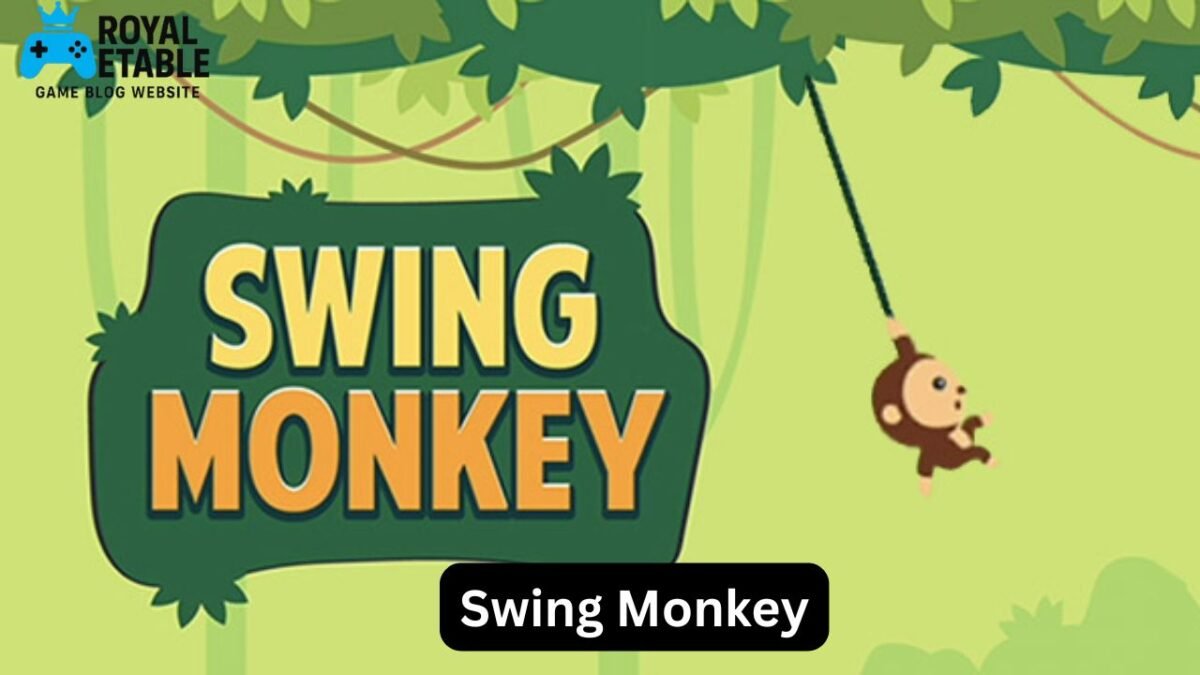
Swing Monkey is a physics-based arcade game built around one simple idea: use swinging momentum to move a monkey through a level.
The monkey attaches to suitable anchor points and swings beneath them. Your main job is to decide when to attach, when to release, and when to connect to the next point.
That sounds simple because the control system is simple. The challenge comes from the physics.
A successful swing depends on several things:
- The monkey’s current speed
- The position of the next anchor
- The angle of the swing
- Your release timing
- Obstacles and gaps in the route
- How quickly you react to the changing trajectory
The important lesson is that you are not really controlling the monkey’s movement directly. You are controlling the timing that influences its movement.
That distinction explains much of the game’s difficulty.
How to Play Swing Monkey
The basic gameplay loop is easy to learn.
1. Find an anchor point
Look for a location that the monkey can attach to. The anchor becomes the center of the swing.
2. Build momentum
Once attached, the monkey moves in an arc. Instead of immediately releasing, watch how its position changes.
3. Release at the right moment
Your release determines the monkey’s next trajectory.
Releasing too early can leave you short of the next platform or anchor. Releasing too late can send you into an obstacle or away from the intended route.
4. Attach again
If another anchor is available, connect to it and repeat the process.
The best players eventually stop thinking about each swing individually. They begin reading the next two or three movements before releasing.
Why Swing Monkey Gets Harder
One of the interesting things about Swing Monkey is that the controls don’t necessarily become dramatically more complicated. Instead, the situations become less forgiving.
Early sections give you enough room to experiment. You can attach, swing, release, and recover from small mistakes.
Later sections may require:
- Faster decisions
- More accurate release points
- Longer swings
- Better positioning
- Rapid transitions between anchors
- Greater awareness of obstacles
This creates an important psychological shift.
At the beginning, you are learning how to swing.
Later, you are learning when not to swing.
That second skill is easy to overlook. Sometimes the safest move is to wait for a better trajectory rather than immediately jumping toward the next anchor.
Swing Monkey Levels: What to Expect
Searching for Swing Monkey levels is common because players quickly notice that progression changes the character of the game.
Rather than judging a level only by how far the monkey has to travel, look at its structure.
Short levels
These are useful for learning:
- Basic attachment
- Swing timing
- Release control
- Momentum
They are also good places to experiment with different approaches without worrying too much about failure.
Longer levels
Longer sections require better planning.
You may need to connect several points in succession, meaning that a mistake early in the sequence can affect everything that follows.
A useful approach is to identify the next safe anchor, not necessarily the farthest possible one.
Technical levels
Some sections are difficult because they demand precise timing rather than long-distance movement.
These are the levels where repeatedly rushing usually makes things worse.
Instead:
- Attach securely.
- Watch the swing.
- Identify the highest-value release moment.
- Release deliberately.
- Immediately look for the next anchor.
The Most Important Skill: Release Timing
If you only improve one thing in Swing Monkey, improve your release timing.
A common beginner mistake is releasing because the monkey looks close to the destination.
Visual distance can be misleading.
The monkey’s momentum matters just as much as its position.
Imagine the monkey is swinging toward the right. It may look perfectly aligned with the next area, but if its current movement is slowing or its angle is unfavorable, releasing at that instant may produce a poor trajectory.
A better rule is:
Release based on where the monkey is going, not just where it is.
This is one of the game’s most useful transferable skills.
A Simple Swing Monkey Strategy
When a section seems difficult, use this five-step method.
Step 1: Stop trying to go fast
Speed feels productive, but unnecessary releases create unnecessary failures.
Step 2: Identify the next anchor
Know where you want to go before releasing.
Step 3: Watch one complete swing
If you are unsure about the timing, observe the movement rather than immediately reacting.
Step 4: Release deliberately
Make the release part of your plan rather than a reflex.
Step 5: Reassess immediately
Once airborne, stop thinking about the previous swing. Focus on the next possible connection.
This approach is especially helpful when the level contains several anchors close together.
Swing Monkey on Math Playground
Swing Monkey Math Playground is a search phrase many players use when looking for the game through Math Playground.
Math Playground is known for browser-based games, particularly games that combine straightforward controls with puzzles, physics, or problem-solving elements. Because Swing Monkey fits the casual browser-game format, players often associate it with the platform.
If you are trying to find the game through a school or browser-games context, the exact availability can depend on the website, device, network restrictions, and whether the particular game is currently offered.
The important point is that Math Playground is not the gameplay mechanic itself. Swing Monkey is the game; Math Playground is one of the platforms players may associate with accessing browser games.
What Does “Swing Monkey Unblocked” Mean?
The phrase Swing Monkey unblocked generally refers to attempts to play the game on a network where certain gaming websites are restricted.
This commonly comes up on:
- School networks
- Workplace networks
- Public computer networks
- Managed Wi-Fi systems
However, “unblocked” does not mean there is a special version of the game with different physics or levels.
It usually describes access through a network where the game is otherwise restricted.
If a game is blocked by an organization, trying random mirror sites is not always a good solution. Such sites can be unreliable, outdated, or filled with intrusive advertising.
A safer approach is to use legitimate access provided by the platform or network administrator.
Swing Monkey Bars and Similar Searches
You may also see searches such as Swing Monkey bars or Swing Monkey bars Math Playground.
This wording can be confusing because players sometimes use “bars” to describe the swinging mechanic or compare the game with monkey-bar movement.
The important distinction is that Swing Monkey is fundamentally about grappling and swinging between anchor points, rather than traditional physical monkey bars.
That difference matters when searching for gameplay information. Looking specifically for “bars” may lead you toward unrelated monkey-bar games or physical activity content.
Common Swing Monkey Mistakes
Many failures aren’t caused by difficult levels. They’re caused by predictable habits.
Releasing too early
This is probably the most common mistake.
You see the destination and release immediately, assuming momentum will carry you there.
Often it doesn’t.
Releasing too late
The opposite problem is equally common.
Players wait for the monkey to reach what looks like the perfect position, only to discover that the trajectory has already become unfavorable.
Ignoring the next anchor
Focusing exclusively on the current swing can leave you unprepared for the next move.
Try to identify the next connection while the current swing is still happening.
Making every swing maximum length
Longer isn’t automatically better.
Sometimes a shorter, controlled movement produces a much better setup for the next swing.
Repeating the same failed timing
If you fail at exactly the same point several times, don’t simply repeat the attempt faster.
Change something:
- Release earlier
- Release later
- Choose another anchor
- Wait for a different swing angle
- Take a safer route
Failure becomes useful only when it gives you information.
Three Less-Obvious Tricks That Make a Difference
Here are three practical observations that aren’t always emphasized in basic Swing Monkey guides.
1. Your best route isn’t always the shortest route
A visually direct path can require extremely precise timing.
A slightly longer route may provide more predictable anchor positions and a larger margin for error.
For difficult levels, prioritize reliability over distance.
2. Treat failed attempts as timing measurements
Instead of thinking, “I lost again,” ask:
Where exactly did the trajectory go wrong?
If you consistently fall short, your release probably needs to happen later or from a different position.
If you repeatedly overshoot, the opposite may be true.
This turns trial and error into a simple feedback loop.
3. Learn the rhythm, not just the controls
After several attempts, many sections develop a recognizable rhythm:
attach → build momentum → release → reconnect → repeat
Once that rhythm becomes familiar, your reactions become less conscious.
This is why Swing Monkey can feel difficult for the first few minutes and then suddenly become much easier.
Swing Monkey vs. Typical Casual Browser Games
Swing Monkey has a different feel from games where the primary challenge is memorizing instructions or solving static puzzles.
| Feature | Swing Monkey | Typical Simple Arcade Game |
|---|---|---|
| Main skill | Timing and momentum | Reaction or tapping |
| Physics | Important | Often limited |
| Controls | Simple | Simple to moderate |
| Difficulty | Increases through precision | Often increases through speed |
| Strategy | Route and release timing | Immediate reaction |
| Replay value | High | Depends on game |
The simplicity is actually one of Swing Monkey’s strengths.
You don’t have to learn a complicated control system before you can start improving.
How to Get Better Faster
If you are stuck on a particular Swing Monkey level, don’t simply play it repeatedly without changing your approach.
Try this routine:
- Play slowly for the first few attempts.
- Identify every possible anchor.
- Notice where your character begins losing momentum.
- Experiment with release timing.
- Choose the safest route rather than the fastest-looking route.
- Once you understand the section, increase your pace.
This works because you are separating learning the level from executing the level.
Trying to do both simultaneously is often what makes difficult sections feel chaotic.
Is Swing Monkey Good for Younger Players?
The basic mechanic is easy to understand, making the game accessible to a wide range of players.
It can also encourage practical skills such as:
- Timing
- Visual tracking
- Anticipation
- Spatial awareness
- Cause-and-effect reasoning
- Patience
It shouldn’t be confused with a formal mathematics game simply because some searches connect it with Math Playground. Its primary challenge is physics-style timing and coordination rather than solving mathematical equations.
FAQ
What is Swing Monkey game?
Swing Monkey is a casual physics-based arcade game in which you guide a monkey by attaching it to anchor points and swinging between them. The main challenge is controlling momentum and releasing at the right moment. As levels become more demanding, timing and route selection become increasingly important.
How do you play Swing Monkey on Math Playground?
If Swing Monkey is available through Math Playground, gameplay follows the same basic principle: attach to an anchor, swing, release, and connect to the next useful point. Availability can vary depending on the platform and network you are using. If the game does not load, the issue may be access or compatibility rather than your gameplay.
What makes Swing Monkey levels difficult?
Later Swing Monkey levels generally become harder because they give you less room for timing errors and require more deliberate movement. The challenge isn’t necessarily more complicated controls. Instead, you have to manage momentum, release at better moments, and select safer routes.
Is Swing Monkey unblocked a different version of the game?
Usually, “unblocked” describes access rather than a separate version of Swing Monkey. Players commonly use the phrase when looking for a way to play browser games on restricted networks. The game’s underlying mechanics and level design do not become different simply because someone describes it as unblocked.
How can I get better at Swing Monkey?
Focus on release timing before trying to play faster. Watch the monkey’s direction and momentum, identify your next anchor before releasing, and learn from exactly where failed attempts go wrong. Once you understand the rhythm of a section, your speed will naturally improve.
Final Thoughts
Swing Monkey succeeds because it turns a tiny set of controls into a surprisingly deep timing challenge. You don’t need complicated combinations or a large rulebook; you need to understand momentum, anticipate the next movement, and make better decisions under pressure.
Whether you found the game through Math Playground, searched for Swing Monkey unblocked, or simply want help getting through difficult Swing Monkey levels, the same principle applies: don’t chase speed before you understand control.
Learn the route, study the swing, adjust your release timing, and use failed attempts as information. Once those habits become automatic, sections that initially feel unpredictable start to become much more manageable.