


Table of Contents
ToggleIf you are building a Chaos Space Marines army, the hardest part is often not choosing your models—it is understanding how the different units actually fit together on the tabletop. Legionaries, Combat Patrol boxes, daemon engines, characters, and larger battleforce-style collections can all look attractive, but they serve very different purposes.
This guide breaks down Chaos Space Marines for players who are starting an army, expanding an existing collection, or trying to understand the faction’s current datasheets and unit choices. It also explains where Legionaries fit, what a Combat Patrol gives you, why the Defiler matters, and how to think about adding other Chaos Space Marines miniatures without simply buying whatever looks impressive.
The rules and points used in Warhammer 40,000 change over time, so the most important practical lesson is to check the current faction pack and Munitorum Field Manual before building a matched-play list. Games Workshop’s current Chaos Space Marines faction pack includes updated rules and datasheets, while the current points document lists units such as Legionaries, Defilers, Chosen, Terminators, Possessed, and Forgefiends.
What Are Chaos Space Marines?
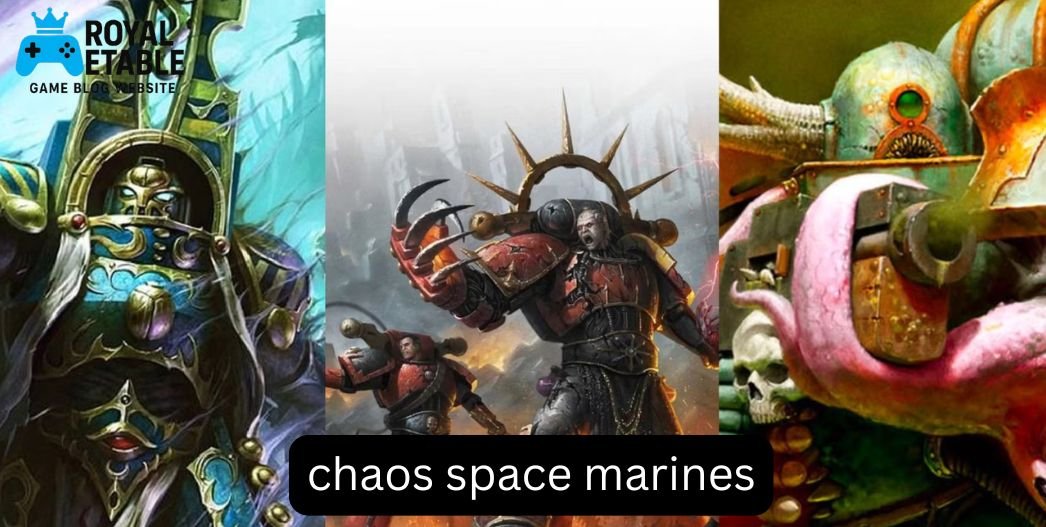
Chaos Space Marines are the traitor Astartes of Warhammer 40,000: genetically enhanced warriors who have rejected the Imperium and, in many cases, pledged themselves to the Chaos Gods.
On the tabletop, the faction combines:
- Durable power-armoured infantry
- Strong melee units
- Characters that enhance other units
- Cultist and mortal support
- Daemon Engines
- Powerful shooting platforms
- Flexible specialist units
One reason the faction can be confusing for new players is that Chaos Space Marines is both a faction identity and a large collection of very different battlefield roles.
A Legionary squad and a Defiler are both Chaos units, but you should not expect them to accomplish the same job.
That distinction becomes important when expanding an army.
Chaos Space Marines Combat Patrol: Where Should You Start?
A Combat Patrol is designed to provide a relatively self-contained force for Combat Patrol games rather than simply being a random collection of miniatures.
Games Workshop has previously described its Chaos Space Marines Combat Patrol forces as a useful foundation for a larger collection, with Legionaries providing the infantry anchor and other units contributing specialised roles.
For a new player, the biggest advantage is cohesion.
Instead of purchasing five unrelated units, you can learn how several models interact with one another.
Why Legionaries matter
Legionaries are particularly useful because they are Battleline infantry and can perform several basic battlefield tasks.
The current Combat Patrol datasheet gives Legionaries:
- 6″ Movement
- Toughness 4
- 3+ Save
- 2 Wounds per model
- Objective Control 2
The datasheet also allows the unit to split into two five-model units before the battle, giving the player additional flexibility.
That last point is easy to underestimate.
A large squad can be useful when you want to keep models together, while smaller units can be useful when the mission rewards controlling several areas of the battlefield.
Chaos Space Marines Legionaries: What Do They Actually Do?
Think of Legionaries as your general-purpose Chaos infantry.
They are not necessarily the unit you buy because you want the most spectacular damage output. Their value comes from being adaptable.
Depending on their equipment and the situation, they can:
- Hold an objective.
- Advance toward midfield.
- Provide supporting fire.
- Fight weakened enemy units.
- Screen more valuable models.
- Force the opponent to account for multiple threats.
Their available weapons include options such as a heavy bolter, meltagun, plasma pistol and different melee weapons on the current Combat Patrol datasheet.
A practical Legionaries mistake
A common beginner mistake is treating every infantry unit as something that must immediately charge the enemy.
That is not always correct.
If your Legionaries can score an objective while your more specialised unit prepares a decisive attack elsewhere, they may be doing exactly what you need.
Board control is often more valuable than simply removing another model.
How Dark Pacts Change Chaos Space Marines
One of the defining faction mechanics is Dark Pacts.
The idea is simple: Chaos Space Marines can gain additional offensive potential by making a pact, but doing so comes with a risk.
This creates an interesting decision during the game.
You are effectively asking:
Is the extra offensive benefit worth exposing this unit to the consequences of the pact?
That makes Chaos Space Marines different from an army where every unit simply operates at its maximum efficiency without a meaningful trade-off.
The practical lesson is to avoid using Dark Pacts automatically.
If a unit is already positioned perfectly and only needs to score an objective, the additional risk may not always justify the benefit. If the same unit is about to make an important attack that could swing the turn, the calculation can be very different.
Chaos Space Marines Battleforce Boxes and Army Expansion
Battleforce-style boxes can be tempting because they put several units together in one purchase.
But there is an important distinction between getting many miniatures and building a coherent army.
Before buying a large box, ask:
- Does it contain units you actually want to play?
- Does it duplicate models you already own?
- Can the units work with your preferred detachment?
- Will you realistically paint everything?
- Are you buying it for gameplay, collection, or both?
Games Workshop has previously positioned Chaos Space Marines boxed collections as ways to expand a Combat Patrol into a larger force, including infantry-focused and more specialised options.
The best box for you therefore depends heavily on what is already in your collection.
A useful expansion principle
Build outward from your army’s weaknesses.
For example, if you already have plenty of infantry but struggle against armoured targets, another infantry-heavy purchase may not solve your actual problem.
Instead, consider a unit capable of threatening vehicles or monsters.
That sounds obvious, but it prevents one of the most common miniature-game purchasing mistakes: buying models based entirely on appearance.
Where Does the Defiler Fit?
The Defiler occupies a completely different space from Legionaries.
It is a large Daemon Engine combining substantial ranged weaponry with serious close-combat capability.
The current datasheet describes it as a six-legged Daemon Engine equipped with weapons including the Hades battle cannon, excruciator cannons, heavy missile launcher, heavy baleflamer and shearing claws.
The current Munitorum Field Manual lists the Defiler at 300 points for the first unit, with additional costs for subsequent units and optional weapon upgrades. Because points can change, check the live points document before using that figure for a tournament list.
Why the Defiler is interesting
The Defiler gives Chaos Space Marines something that ordinary infantry cannot provide:
A large model that can threaten targets at both range and close quarters.
That creates pressure on your opponent.
An enemy vehicle cannot necessarily assume that it is safe simply because it has avoided your infantry. At the same time, an opponent cannot casually send a small unit toward the Defiler expecting an easy melee engagement.
Games Workshop’s newer Defiler kit retains numerous weapon options and adds further customisation, making construction an important part of owning the model.
Defiler vs Forgefiend vs Maulerfiend
These units can appear similar to someone new to Chaos Space Marines, but their battlefield identities differ.
| Unit | General role |
|---|---|
| Defiler | Hybrid firepower and melee Daemon Engine |
| Forgefiend | Primarily ranged pressure |
| Maulerfiend | Aggressive close-combat threat |
| Legionaries | Flexible infantry and objective work |
The choice should therefore follow your army’s needs.
If your collection already has enough melee threats, adding another dedicated melee monster may create redundancy.
A hybrid unit can sometimes provide a different kind of pressure.
Chaos Space Marines Datasheets: How to Read Them
A datasheet can look intimidating when you first open one.
Do not try to memorise every number.
Instead, read it in this order:
1. Movement
Movement tells you how quickly the unit can influence the board.
A unit with excellent damage but poor positioning can still struggle.
2. Toughness and Save
These give you a rough idea of how difficult the model is to remove.
But never judge durability from one statistic alone.
3. Wounds
Wounds tell you how much damage an individual model can absorb before being destroyed.
This becomes especially important when comparing elite infantry with ordinary troops.
4. Weapons
Look at:
- Range
- Attacks
- Strength
- Armour Penetration
- Damage
- Special abilities
Do not automatically choose the weapon with the biggest Strength value.
The best weapon depends on what you expect the unit to fight.
5. Abilities
This is where many of the interesting interactions live.
A unit’s ability can matter more than a small difference in its raw weapon profile.
6. Keywords
Keywords determine which rules, abilities and interactions apply to the unit.
This is particularly important when constructing a larger army.
Other Chaos Space Marines Miniatures Worth Considering
Once you have your initial force, the Chaos range gives you many directions to explore.
Chosen
Chosen are elite Chaos Space Marines that can add more concentrated combat power.
The current Munitorum Field Manual lists five- and ten-model options, making them a potential step upward from basic infantry.
Chaos Terminators
Terminators provide a much more elite profile and can form the centre of a force designed around heavily armoured infantry.
They also interact with specific characters such as a Terminator-armoured Chaos Lord or Sorcerer.
Possessed
Possessed offer a more aggressive, mutated interpretation of Chaos Space Marines.
They are especially interesting for players who want an army that puts pressure on the opponent through movement and melee threats.
Havocs
Havocs provide heavier infantry-based firepower.
They can be useful when you want your army to threaten targets without relying entirely on Daemon Engines.
Raptors and Warp Talons
These units give you greater mobility and can change how quickly your army reaches vulnerable parts of the opponent’s deployment.
They are particularly useful when your game plan depends on threatening multiple locations rather than advancing everything through the centre.
Three Less-Obvious Lessons About Building Chaos Space Marines
1. A flexible unit can be more valuable than a stronger unit
New players often search for the unit with the best damage output.
But a unit that can score, screen, fight and shoot may solve more problems across a five-round game.
Legionaries demonstrate this principle particularly well.
2. Large models change how your opponent moves
A Defiler does not need to destroy three enemy units to influence the game.
Its presence can force an opponent to:
- Stay away from certain areas.
- Protect vulnerable units.
- Change vehicle positioning.
- Spend resources dealing with it.
That psychological and positional pressure is easy to overlook when looking only at datasheet numbers.
3. Your army should have multiple answers to the same problem
Suppose an opponent brings a heavily armoured target.
If your entire strategy depends on one meltagun squad destroying it, you have created a single point of failure.
A stronger army structure gives you several possible answers: concentrated shooting, melee pressure, specialised weapons, or simply objective control that forces the opponent to move.
That redundancy becomes increasingly important as games become more competitive.
Common Chaos Space Marines Mistakes
Buying models without a battlefield plan
A beautiful miniature can still sit unused if it does not fit your army.
Taking too many expensive units
A collection filled with elite models can look impressive but leave you short on units capable of controlling multiple objectives.
Ignoring mission objectives
Warhammer 40,000 is not simply a destruction contest.
A unit surviving on an objective can matter more than another unit killing something elsewhere.
Building every unit for maximum damage
Maximum damage is not the same thing as maximum usefulness.
Think about range, positioning, durability, objective control and role.
Forgetting to check updated rules
This is particularly important for Chaos Space Marines because rules, points and datasheets can change.
The current faction pack is explicitly versioned, and Games Workshop states that points and wider balance changes are updated through its official systems.
A Simple Chaos Space Marines Expansion Path
If you are starting from scratch, a sensible approach is:
Step 1: Learn your Combat Patrol.
Step 2: Understand what your Legionaries are doing each game.
Step 3: Identify the army’s biggest weakness.
Step 4: Add a unit that addresses that weakness.
Step 5: Play several games before buying another large batch.
This is much more informative than building an army entirely from a theoretical list.
After five or ten games, you will know whether you actually need more shooting, faster units, tougher infantry, objective holders or heavy targets.
FAQ
What are Chaos Space Marines in Warhammer 40K?
Chaos Space Marines are traitor or renegade Space Marines who fight against the Imperium and often serve the Chaos Gods. On the tabletop, the faction combines infantry, elite warriors, characters, mortal followers and Daemon Engines. Its Dark Pacts mechanic gives the army an additional layer of risk-and-reward decision-making.
Are Chaos Space Marines Legionaries good for beginners?
Legionaries are a practical starting point because they are flexible infantry rather than a highly specialised unit. Their current Combat Patrol datasheet gives them 3+ saves, two wounds per model and Objective Control 2, while their weapon options allow different battlefield roles.
Is the Defiler a Chaos Space Marines unit?
Yes. The Defiler is a Chaos Space Marines Daemon Engine with both ranged and melee capabilities. Its current datasheet includes a mixture of cannons, missiles, flamers and large melee weapons, making it considerably more versatile than a simple dedicated melee monster.
What should I buy after a Chaos Space Marines Combat Patrol?
There is no universal next purchase because it depends on the models already in your collection and how you want to play. A useful approach is to identify your biggest battlefield gap first, then choose a unit that fills it rather than simply buying another version of something you already have.
Where can I find current Chaos Space Marines datasheets and points?
The current faction pack provides the latest faction rules and clarifications, while the Munitorum Field Manual provides current points values. Because Warhammer 40,000 receives balance updates, checking the current documents before a matched-play game is safer than relying on an older printed value.
Conclusion
Chaos Space Marines are at their most interesting when you stop viewing the army as a collection of powerful miniatures and start thinking about roles and interactions.
Legionaries give you adaptable infantry and objective presence. Elite units provide specialised threats. Daemon Engines such as the Defiler add large-scale pressure and force opponents to respect different parts of the battlefield.
If you are starting a collection, learn the Combat Patrol first, play enough games to discover what your army lacks, and expand from there. That approach gives every new Chaos Space Marines miniature a purpose instead of leaving you with an impressive pile of models and no clear plan for using them.